
How to Choose a Tethered Power Supply for UAVs: 6 Key Technical Parameters
Choose a tethered UAV power supply by matching continuous and peak demand, input and output voltage, power quality, tether mass and loss, environmental protection, and aircraft compatibility. Evaluate the complete ground-to-air power chain against the intended mission, then request configuration-specific evidence before purchase.
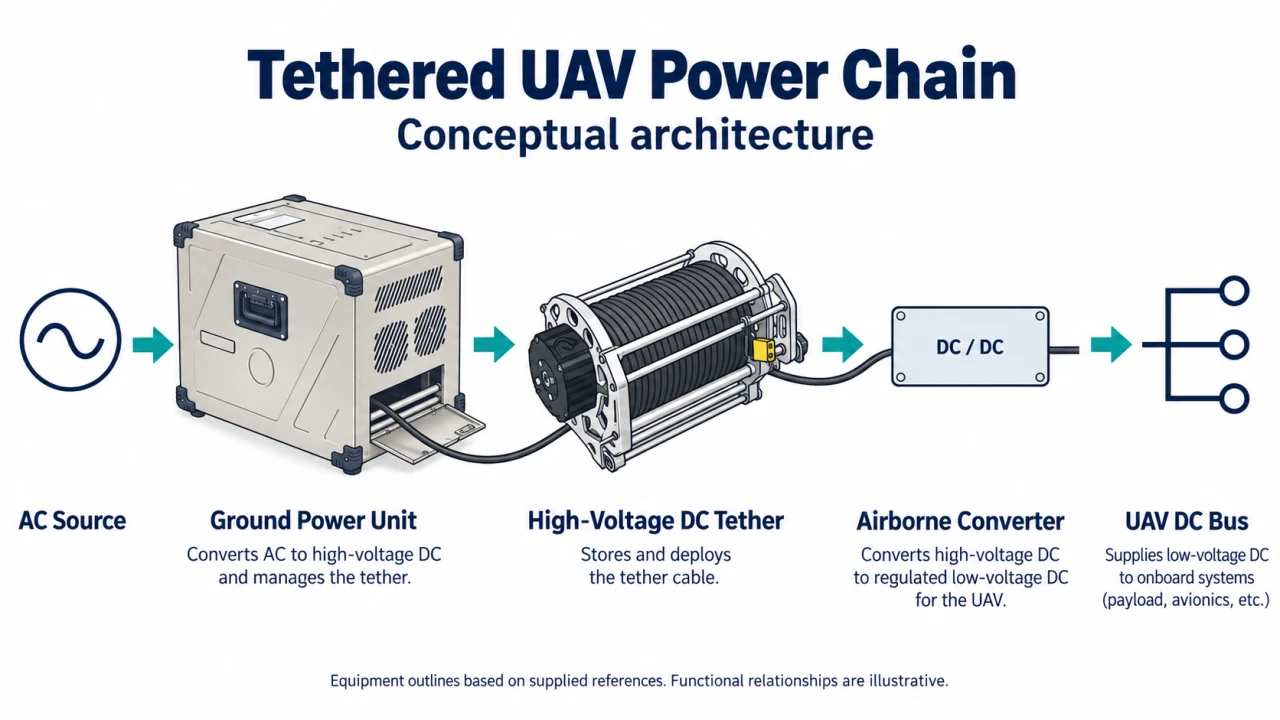
Selecting a tethered UAV power supply is not simply a matter of matching a power rating to a drone.
For professional applications such as persistent surveillance, emergency response, infrastructure monitoring, communication relay and aerial lighting, the tethered power system becomes part of the UAV’s overall power architecture.
A suitable system must deliver sufficient power to the aircraft and payload while maintaining stable voltage, acceptable tether weight, low transmission loss and reliable protection during long-duration operation.
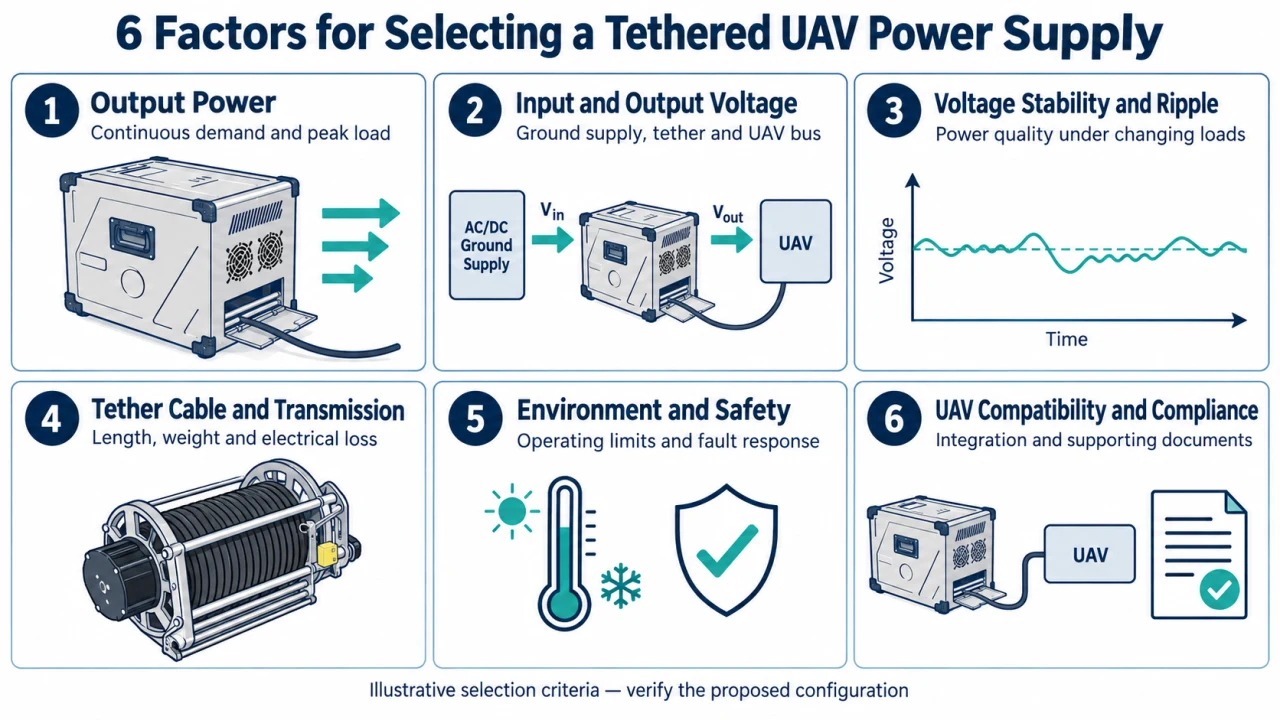
This guide explains six technical parameters that should be evaluated before selecting from available tethered UAV power systems.
1 Maximum Output Power
Maximum output power is one of the first specifications to evaluate.
A tethered power supply must support the continuous power demand of the UAV as well as additional mission payloads such as:
- LED lighting systems
- EO/IR cameras
- Communication relay equipment
- Loudspeakers
- Sensors and monitoring equipment
For illustration, a system rated at 3 kW, 7 kW or 15 kW does not automatically mean that the entire rated power is available to the UAV under every operating condition.
Engineers should consider:
UAV power consumption + payload power consumption + conversion losses + operating margin.
For this reason, power-system selection should begin with the actual UAV configuration and mission profile rather than nominal power alone.
2 Input and Output Voltage
Voltage architecture is particularly important in tethered UAV systems.
A typical system may include:
Ground-side input may depend on the operating environment, while the tether transmission voltage can be significantly higher.
Why use high-voltage DC transmission?
Because transmitting the same amount of power at a higher voltage reduces the required current. Lower current can help reduce cable conductor size, cable weight and transmission losses.
This becomes increasingly important as tether length and UAV power requirements increase.
3 Voltage Stability and Ripple
Maximum power alone does not determine power quality.
The airborne power module must provide stable electrical output compatible with the UAV’s power system.
Important parameters include:
- output-voltage tolerance;
- voltage ripple;
- transient response;
- voltage drop under load;
- behavior during sudden payload changes.
Poor power quality can affect sensitive onboard electronics and mission payloads.
Therefore, buyers should request actual test data rather than relying only on nominal output-voltage specifications.
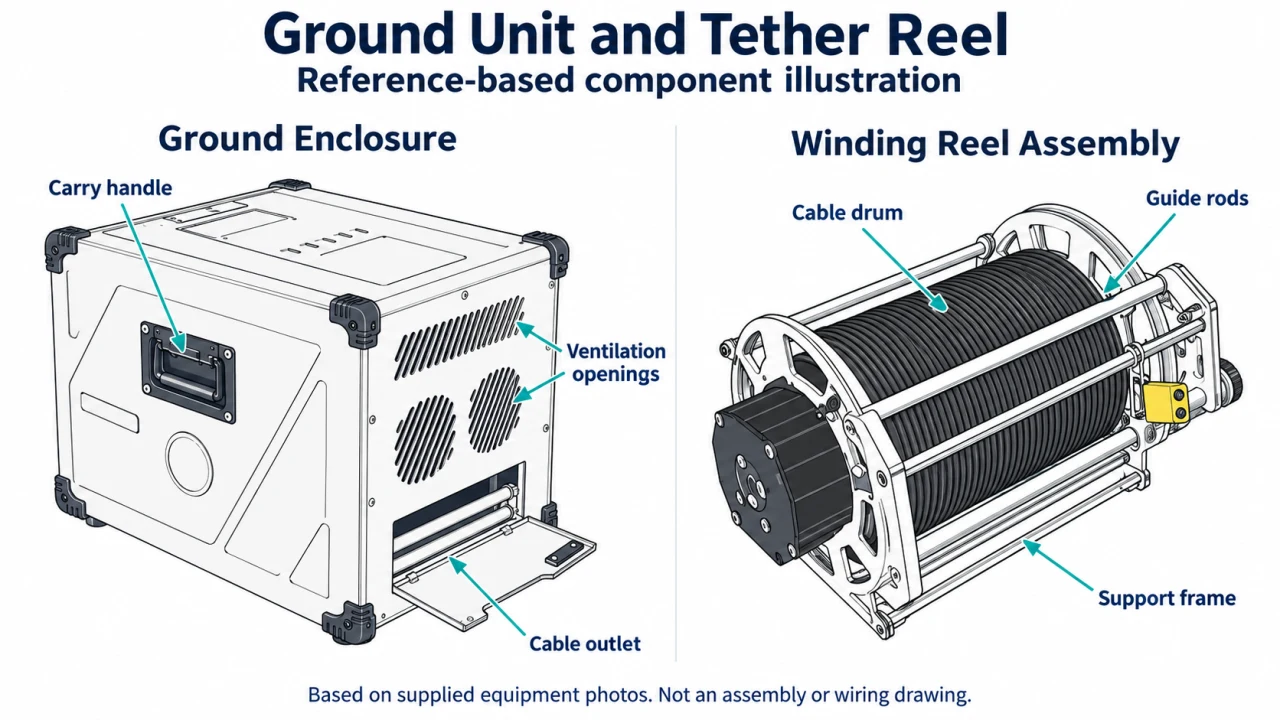
4 Tether Cable Length, Weight and Transmission Loss
The tether is both a power-transmission component and a physical load carried by the aircraft.
Important specifications include:
For long-tether operations, evaluating cable length without cable weight and voltage drop can produce misleading conclusions.
5 Environmental and Safety Protection
Professional tethered UAV systems frequently operate outdoors for extended periods.
Key parameters therefore include:
- operating temperature;
- IP rating;
- operating altitude;
- over-voltage protection;
- over-current protection;
- short-circuit protection;
- over-temperature protection;
- leakage protection;
- tether tension protection.
This is an important question to ask suppliers:
What happens if ground power suddenly fails during flight?
6 UAV Compatibility and Compliance
A tethered power system should not be selected only by matching the UAV’s nominal battery voltage.
Compatibility assessment should include:
For example, systems intended for different industrial or heavy-lift UAVs may require significantly different power architectures.
Regulatory requirements should also be evaluated according to the final product configuration and target market rather than assuming that one certificate covers every system combination.
How to Select the Right System
Before requesting a quotation, provide your supplier with at least:
UAV model + payload + required operating height + mission type + operating environment + available ground power.
This information allows the supplier to evaluate the complete power chain rather than simply recommend a system based on maximum wattage.
Frequently Asked Questions
How much power does a tethered drone need?
It depends on the UAV, payload and operating conditions. Selection should be based on continuous and peak power demand with appropriate system margin.
Why do tethered UAV systems use high-voltage transmission?
Higher transmission voltage reduces current for a given power level, which can help reduce conductor weight and transmission losses.
Can one tethered power supply work with different drones?
Potentially, but compatibility depends on voltage, power requirements, airborne power architecture, connectors and mechanical integration.
What information is required to select a tethered UAV power supply?
At minimum: UAV model, payload, mission, required operating height, operating environment and available ground power.
Discuss Your UAV Configuration
Need help matching a tethered power system to your UAV? Send XINLV SMART your UAV model, payload and mission requirements for configuration evaluation.
XINLV SMART is a system integration, supply-chain and solution provider. Configuration discussions focus on matching the UAV, payload and power-system components. Compatibility, operating limits and available supporting documentation must be confirmed for the proposed configuration.
Request a Configuration Review