
Tethered Drone Power System Safety: 10 Technical Factors Buyers Should Evaluate
Evaluate a tethered drone power system by checking electrical protection, thermal behavior, tether handling, ground-power-loss response, environmental limits, compatibility and documentation. Each protection claim should describe the trigger, system response and recovery procedure for the exact aircraft, payload and power configuration.
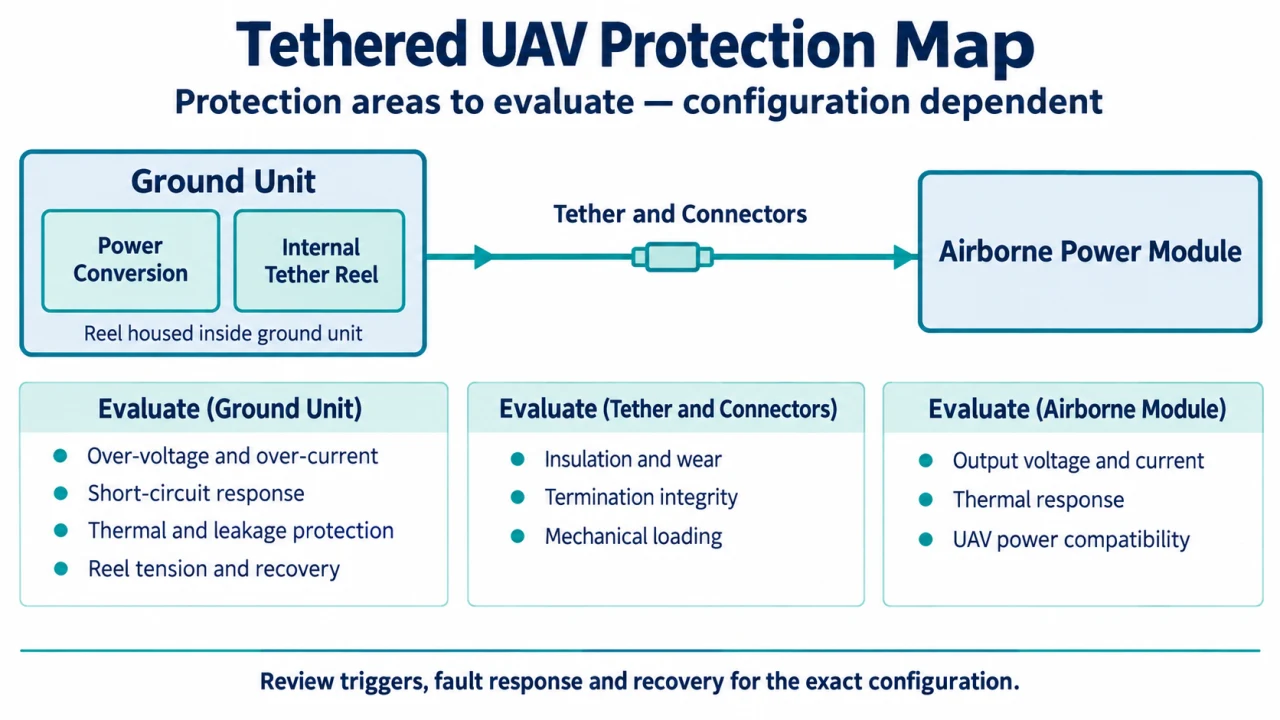
For professional UAV operations, a tethered power supply is not simply an accessory.
It becomes part of the aircraft’s power infrastructure.
A failure in the ground power unit, tether, airborne power module or protection system can affect the entire mission.
For this reason, professional buyers should evaluate safety and reliability alongside output power.
Here are ten factors worth checking.
1 Over Voltage Protection
Abnormal voltage conditions can damage the airborne power module, UAV electronics or mission payload.
Ask the supplier:
What happens when input or output voltage exceeds the specified range?
2 Over Current Protection
Unexpected load changes or electrical faults can produce excessive current.
The power system should detect abnormal conditions and respond according to its protection design.
3 Short Circuit Protection
A short circuit in a high-power tethered system can create significant electrical and thermal stress.
Buyers should understand both:
whether protection exists and how the system behaves after protection is triggered.
4 Over Temperature Protection
Ground power units and airborne converters may operate continuously for long periods.
Thermal protection should therefore be evaluated under realistic load and environmental conditions.
5 Leakage and Electrical Safety
This becomes particularly important for high-voltage tether architectures and outdoor operations.
Ground equipment, connectors, cables and enclosures should be evaluated as part of the overall electrical safety architecture.
6 Tether Tension Protection
The tether is both an electrical and mechanical component.
Unexpected tension can result from:
- wind;
- obstacles;
- deployment errors;
- cable entanglement;
- aircraft movement.
Systems with powered reels should therefore be evaluated for tension management, documented emergency handling strategy and manual recovery capability where applicable.
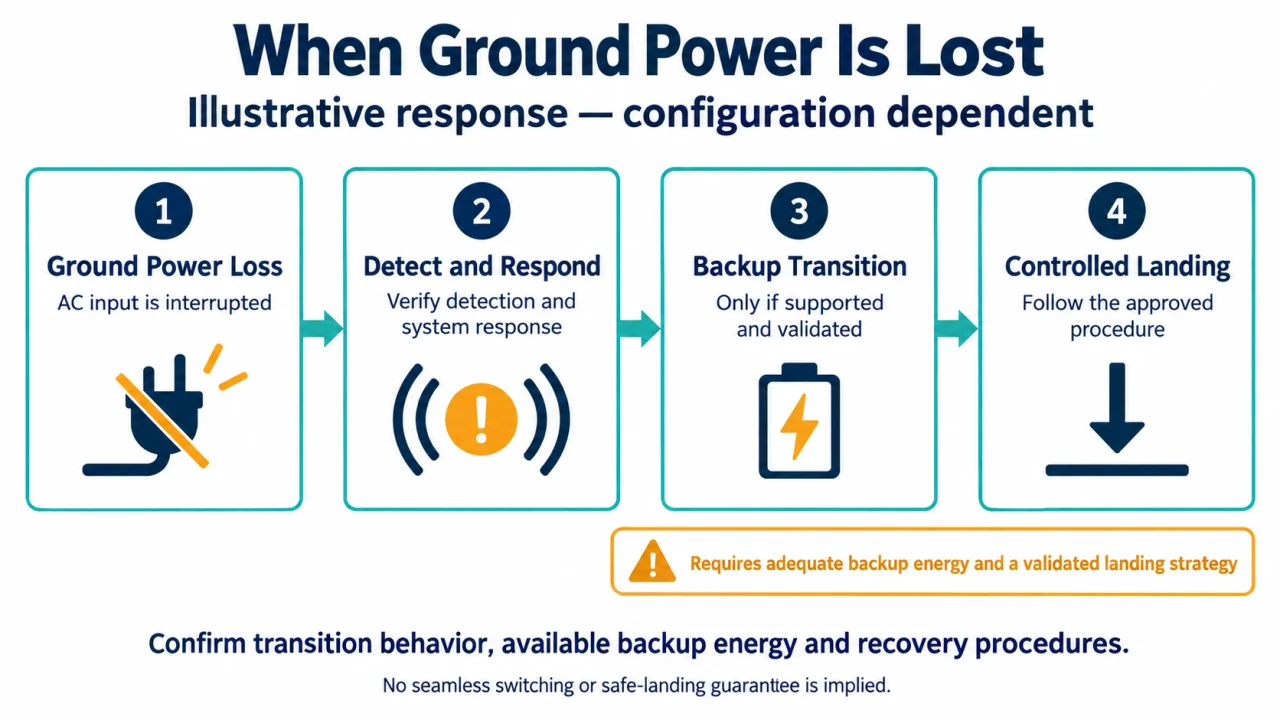
7 Ground Power Failure Strategy
One of the most important questions is:
What happens if AC input power disappears?
Depending on system architecture, a tethered UAV may use its onboard battery as a backup power source.
The transition behavior should be clearly understood and tested for the intended UAV configuration.
8 Environmental Protection
Professional systems may operate in dust, humidity, rain, heat and cold.
Important specifications include:
- operating temperature;
- storage temperature;
- enclosure IP rating;
- altitude limitations;
- derating requirements.
Do not evaluate an IP rating in isolation: determine which component has that rating and under what test conditions.
9 UAV and Payload Compatibility
A power supply may have sufficient nominal wattage but still be unsuitable for a particular UAV.
Compatibility should consider:
This is why a professional supplier should request the UAV model and mission configuration before recommending a system.
10 Compliance and Technical Documentation
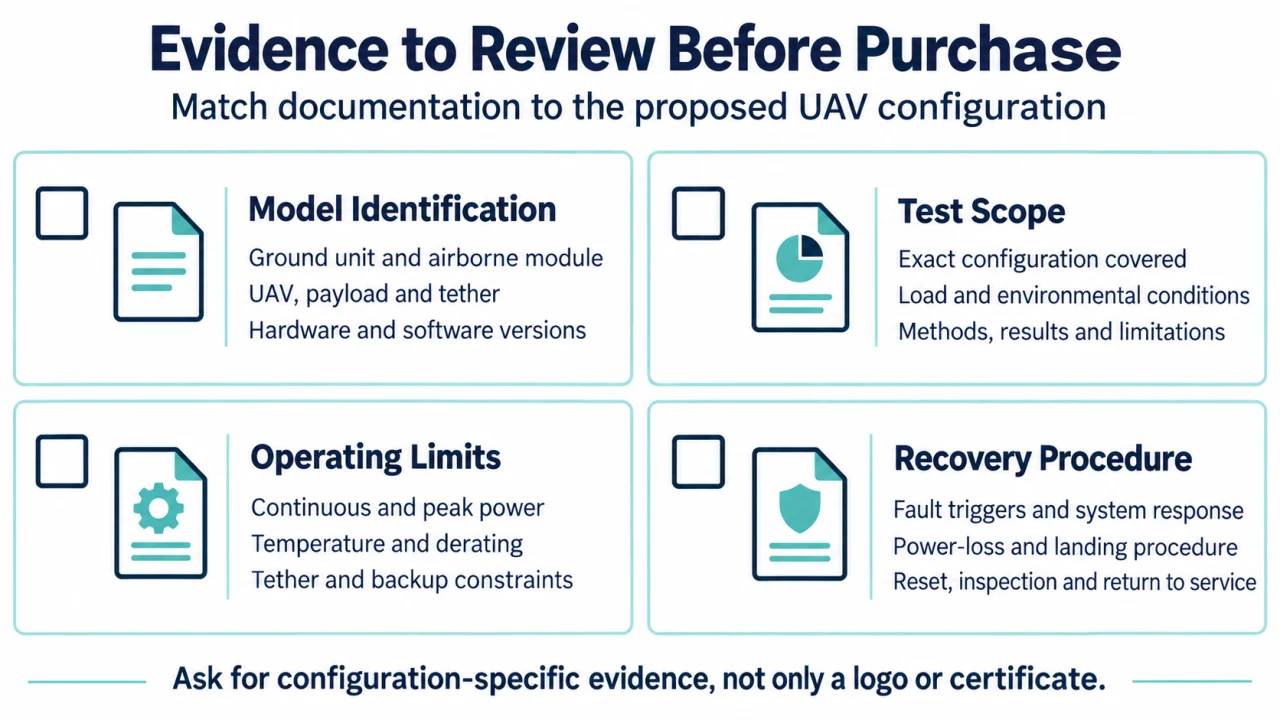
For professional procurement, buyers should ask for relevant technical documentation rather than relying only on a CE logo or a one-page certificate.
Depending on product configuration and target market, documentation may include applicable declarations, test reports, technical specifications, user manuals and compliance records.
A Better Way to Compare Suppliers
Do not compare suppliers only by:
Price + Maximum Power + Cable Length.
Instead compare:
Power quality + tether architecture + environmental capability + protection design + UAV compatibility + documentation + technical support.
For professional B2B procurement, these factors provide a much clearer picture of system suitability.
Further Reading
European Commission guidance on CE marking explains the role of conformity assessment, technical documentation and the EU declaration of conformity. Review the applicable requirements for the actual product and market.
Frequently Asked Questions
What happens if a tethered drone loses ground power?
This depends on system architecture. Some systems are designed to transition to onboard battery power so the UAV can execute an appropriate landing procedure.
What protection should a tethered UAV power supply have?
Typical areas to evaluate include over-voltage, over-current, short-circuit, over-temperature, leakage and mechanical tether protection.
Is CE marking enough to evaluate a tethered UAV system?
CE marking is part of EU market-access compliance where applicable, but professional buyers should also review the underlying technical documentation and whether it covers the actual system configuration being purchased.
Discuss Your UAV Configuration
Evaluating a tethered UAV system for a professional project? Send XINLV SMART your UAV model, operating environment, payload and mission requirements. We can help identify the key power-system parameters that should be evaluated.
XINLV SMART is a system integration, supply-chain and solution provider. Configuration discussions focus on matching the UAV, payload and power-system components. Compatibility, operating limits and available supporting documentation must be confirmed for the proposed configuration.
Request a Configuration Review