
"Ready to Forward Without a Single Edit": Inside a Real 3,000 W Tethered Power RFQ
What a Gulf-region government RFQ for a 3,000 W tethered power system actually demanded — and the reply that nearly lost it.
“Our objective is to receive a complete, professionally organized technical and commercial submission package that is ready to be forwarded directly to the requesting authority without any further editing, modification, or rearrangement on our side.”
That line arrived on day four of a five-day thread. It is the most useful sentence in the whole inquiry, because it explains everything that came before it.
The buyer was not trying to negotiate a lower price. He was assembling a file that a government authority would read, check and hold him accountable for. Every vague word we wrote became a risk he would have to carry. Every inconsistency became a question he could not answer. By the time the thread ended, we had sent four versions of a quotation, four numbered technical documents, a warranty statement, a spare-parts statement, a photo set and a delivery schedule — over a dozen documents, across five days of active messaging, time zones, a weekend and a few very late nights.
We have generalised the project throughout. No customer name, no pricing, no commercial terms, no document numbers. What follows is the process, because that is the part worth sharing.
The RFQ arrived with the specification already written
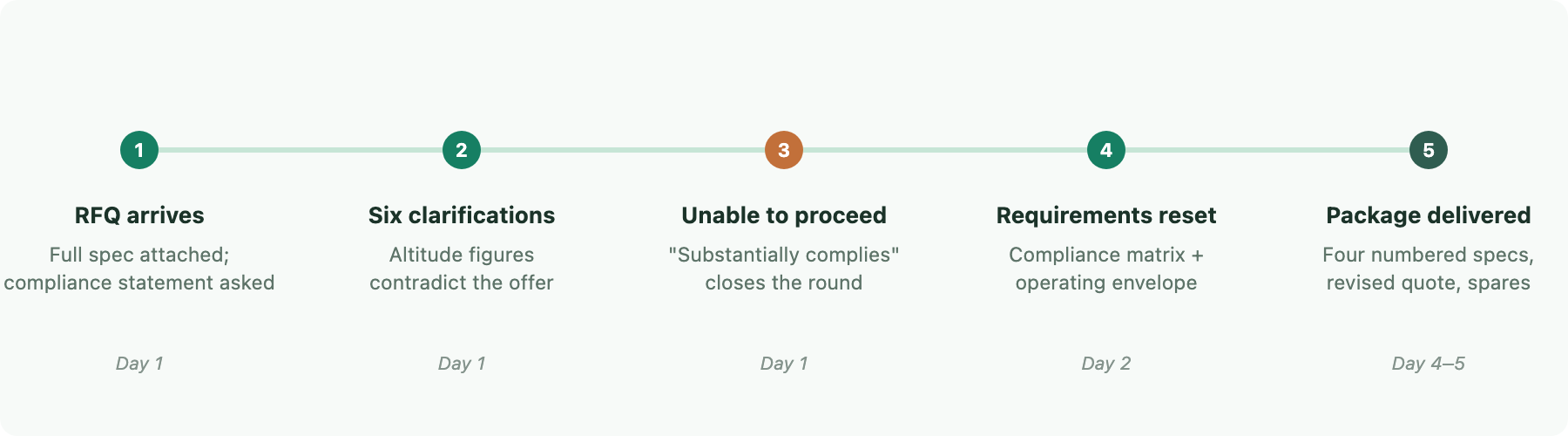
The opening message was not “send me your catalogue”. It was a structured RFQ for one complete 3,000 W tethered drone power supply system, with the required values typed out: input and output voltage ranges, an adjustable high-voltage output, ground-unit dimensions and weight, airborne output voltage, rated power, airborne module dimensions and mass — and three operating altitudes, 55 m, 110 m and 160 m.
Then came six technical clarifications: does the system fully comply; which DJI platforms are compatible (M30/M30T and M300/350 RTK were named); is the 3,000 W continuous or peak; what is the maximum altitude per aircraft; exactly what is in the box; is any customisation required. Then the commercial list: unit price, freight to destination, lead time, warranty, country of manufacture, catalogue and datasheets, payment terms and quotation validity.
And one line that should have set the tone for everything we sent afterwards: “We also request an official technical compliance statement, clearly identifying any differences between your proposed system and our required specifications.”
The buyer already had a specification, almost certainly written around another product. He was not asking us to describe our system. He was asking us to reconcile ours against his, line by line, in writing.
Related reading: How to Choose a Tethered Power Supply for UAVs
The reply that nearly ended the project
Our first technical answer did not do that. We listed our own figures — a narrower input range, a narrower adjustable output range, different dimensions, a heavier ground unit — and summarised the gap as “substantially complies”, with “minor deviations in dimensions and weight”. We also said M30 compatibility was technically possible but “carries operational risk, which we do not recommend”, and quoted altitude limits below 100 m for the M300/M350 and below 150 m for the M400.
The buyer came back with six precise questions within the hour. The first was the killer: your proposal says 55 / 110 / 160 m, but your stated limits are below 100 m and below 150 m — can safe, continuous operation at 160 m actually be achieved, and on which aircraft?
Two messages later the project was closed: “we regret to inform you that the proposed system does not fully comply with the technical requirements of the requesting authority… we are unable to proceed with your current proposal.”
We asked what he actually needed. He restated six hard requirements — full compatibility across M30, M30T, M300, M350 and M400; safe continuous operation at 55, 110 and 160 m; 24 hours or longer; one ground station with interchangeable modules; automatic cable management and full electrical protection; reliable operation in Gulf summer heat — and named his priority: full M30/M30T compatibility and safe, continuous operation at 160 m.
What reopened the conversation was not a better brochure. It was replacing “complies” with a compliance matrix:
| Requirement | Our position | Status |
|---|---|---|
| Ground input voltage range | Narrower than specified | Deviation — stated |
| Adjustable high-voltage output | Narrower than specified | Deviation — stated |
| Ground unit dimensions and weight | Different from specified | Deviation — stated |
| Airborne output voltage | Slight offset | Minor deviation — stated |
| 3,000 W rated output | Continuous rated, higher transient headroom | Compliant |
| Platform compatibility | Dedicated airborne module per aircraft class | Compliant with stated conditions |
| Accessories and scope of supply | Full set listed | Compliant |
We also stopped giving single numbers where what mattered was the envelope. At 160 m, sustained operation depends on wind, ambient temperature and payload: the tether transmits dynamic loads to the airframe and must dissipate its own heat. We stated the wind and payload conditions, explained why the M30’s low ground clearance puts the cable near the rotor disc, and offered extended landing gear plus staged commissioning from 30–50 m. We said plainly that only one aircraft class is fully rated for 160 m across normal conditions, and recommended assigning missions accordingly.
Lesson: in a compliance review, “substantially” means “no”. A deviation the buyer cannot explain to a third party is a deviation he cannot submit. Listing ours openly is what brought the project back.
Related reading: Tethered Drone Power System Safety: 10 Technical Factors
The buyer was reading for internal consistency
Once the technical baseline was settled, the questions changed character. They stopped being about the product and started being about whether our own documents agreed with each other.
Altitude. We had quoted 55 / 110 / 160 m as cable length options while also quoting 100 m and 150 m as stable working altitudes. The buyer asked which was which. The honest answer: the first set is cable length, the second is a practical working ceiling, and a longer cable does not automatically buy more height. Surplus cable on the drum impairs heat dissipation and raises the risk of jumping or tangling during automatic retraction. Cable length should be matched to the mission, not maximised.
Stock. We said all items were in stock, and separately that preparation before dispatch would take at least seven days because every unit goes through more than twenty tests. The reply came straight back: if everything is in stock, why seven days — and can the units be tested and packed in three to five?
Freight. Would a single freight figure cover direct air freight to the destination airport, with no transit through a third country, or sea freight? The final message in the thread, after the whole package had been delivered, was still asking us to confirm that one line.
Documents. After we issued a revised quotation, the buyer asked whether the technical specifications already sent were final, still applicable to the new quotation, and safe to submit together. Because those documents had been translated from the manufacturer’s Chinese originals — including the text inside the diagrams — we said we would have our technical department review them before confirming. That was the right answer. A translated figure nobody has re-checked is not a verified figure.
Related reading: Tethered UAV Power Explained: Power, Voltage and Cable Weight
There is a fourth consistency problem worth naming, because it is a commercial one. A number typed quickly into a chat thread was treated, correctly, as a quoted figure and immediately used as the basis for a discount request. We corrected it, but the lesson stays: every number in a message is a commercial statement. Only written, checked figures belong in an official document.
“Actual photographs of the exact models, not similar products”
The photo request came three times, each more specific than the last. First: high-resolution images of the ground station, the reel, all three airborne modules, the full accessory set and the system operating with a DJI aircraft — “representing the exact models included in your quotation, not similar products”. Then: multiple angles, control panel, display, drum, connection interfaces, technical labels, each module separately, every connector and adapter. Then: “actual equipment being offered, rather than generic promotional images”.
We understood why when he explained himself on day four: “this equipment is intended for a highly sensitive and important government authority, and I want to ensure that everything is accurate… I cannot afford to make any mistakes or provide incorrect technical information, as maintaining the authority’s trust and confidence is extremely important to me.”
He was not collecting pictures. He was putting his own credibility behind them. In preparing the set we found an AI-generated image among the material and removed it. A render on a government submission is not a shortcut — it is a liability.
The real deliverable: a package the buyer does not have to rearrange
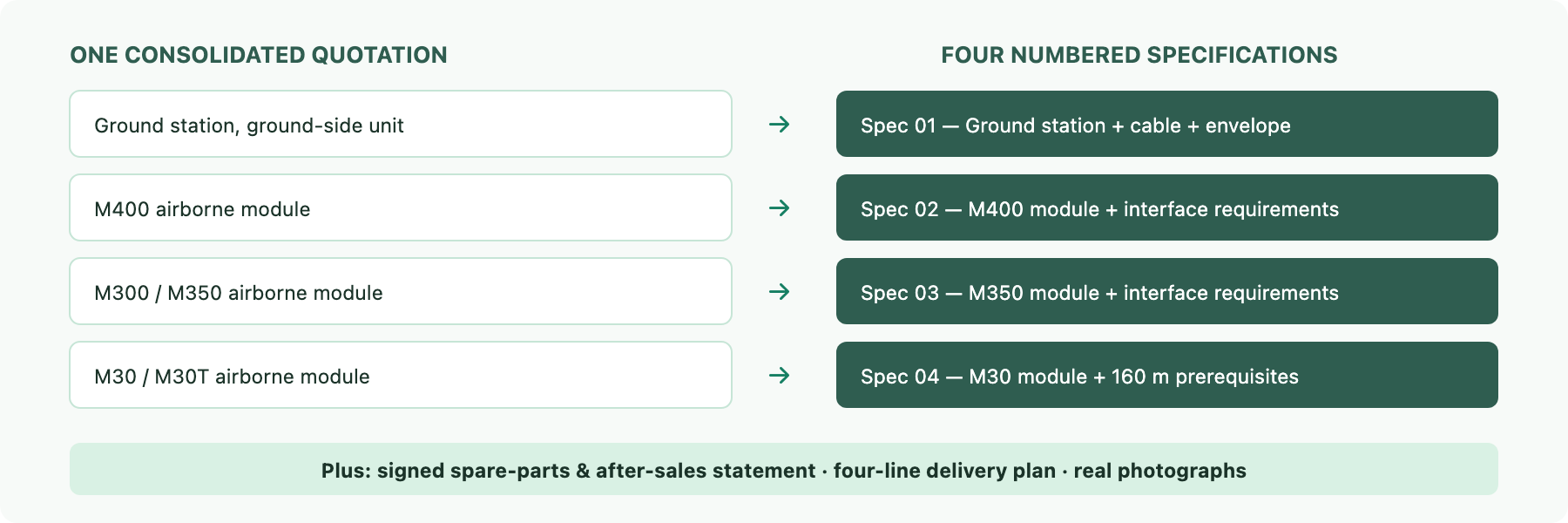
By day four the request had become structural. The buyer wanted one consolidated quotation with the ground station and every airborne module listed separately at individual prices, and one dedicated technical PDF for each quoted unit, with complete specifications and high-resolution images, formally verified by our technical department. All of it “ready to be forwarded directly to the requesting authority without any further editing, modification, or rearrangement on our side”.
That sentence should be printed on the wall of every export sales office. Our internal product structure did not match it. We had been sending three combined manuals, each covering the ground station plus one airborne module. A reviewer trying to check a single quote line had to open three documents and reconcile them.
So we reorganised around how the reviewer reads:
- One ground-station document covering the platform, the tether cable, the protection logic and the operating envelope
- One document per airborne module, each with its own specification, photographs and the interface requirements of the ground station it pairs with
- A document number on each, cross-referenced on the matching line of the quotation
- A short, four-line delivery plan instead of a long schedule
- A signed spare-parts and after-sales statement as an annex, also issued as a standalone one-page document for direct submission
- A bilingual line-by-line check table internally, so every translated parameter could be verified against the original before anything went out
The quotation changed shape too: ground-side and air-side priced separately, freight fixed with no surcharge, direct routing stated explicitly, and the technical summary removed entirely. The arithmetic stayed visible — subtotal, package adjustment, freight, discount, total — because a reviewer will re-add it.
Lesson: organise documents in the order the evaluator will read them, not in the order your factory builds them. A cross-reference between a quote line and a numbered specification is worth more than another twenty pages of catalogue.
Related reading: Products — UAV & Intelligent Equipment · DJI Matrice 30 Series Tethered Power System · DJI Matrice 350 RTK Tethered Power System · DJI Matrice 400 Tethered Power System
The last request was about year three, not day one
After the technical set and the revised quotation, one more message arrived: please include a clear statement in the revised quotation confirming the availability and supply of original spare parts for the ground station and all airborne modules; confirm parts can be ordered separately in future; give the estimated lead time; and confirm technical support and maintenance remain available after the warranty period. The reason was stated plainly — “for the requesting authority to ensure long-term operational reliability and maintenance support.”
We issued it as an annex with seven clauses: scope, genuine OEM parts, separate ordering, an estimated lead-time table, post-warranty support, continuity of supply, and the statement’s status as part of the quotation. It carries signature and company-stamp lines, and a standalone copy for direct submission.
For an institutional buyer, the purchase price is not the risk. The risk is being unable to keep the system airborne in year three, with no parts, no documentation and nobody to call. If you sell into public-sector programmes, this document is not an afterthought — it is often the one that decides the evaluation.
Related reading: FAQ
A checklist for your own RFQ
Twelve questions that separate a submission-ready offer from a brochure:
- Put your required values in a table and ask for a line-by-line compliance matrix. Reject “substantially complies”.
- State altitude as height above ground, and ask the supplier to distinguish it from cable length.
- Ask whether rated power is continuous or peak, and for the overload and protection list.
- Ask for the operating envelope at maximum altitude — wind, payload, temperature — not a single maximum figure.
- Ask which aircraft classes are fully rated at that altitude and which carry restrictions.
- Require the test conditions behind every temperature or endurance claim, including solar radiation and any derating curve.
- Require real photographs of the exact quoted configuration; state that renders and “similar products” will be rejected.
- Require one numbered technical document per quoted line, cross-referenced in the quotation.
- Ask for written confirmation from the technical department that translated or revised documents match the final quotation.
- Ask for a signed spare-parts and post-warranty support statement, with lead times and a discontinuity notice.
- Pin down trade terms, freight mode, transit/transshipment, the delivery clock and customs responsibilities in one place — and check they do not contradict each other.
- Say explicitly that the package must be forwardable without further editing. It changes how a supplier organises everything.
What we would do differently
Three things, stated plainly.
We would open with the compliance matrix instead of a product description. We would never let a figure appear in a chat thread before it has been checked against the document it will end up in. And we would treat “can these documents be submitted together?” as the real acceptance test — because that is the moment the buyer stops evaluating our equipment and starts defending it.
The thread had a human side too: a first message after midnight, a “good dreams, night” at 1 a.m., a weekend reminder, a buyer apologising for “the numerous questions”, a mention of a third visit to the Canton Fair, an invitation to Nanjing, and a line about trust, honesty and mutual respect being the foundation of long-term cooperation. The volume of questions was never friction. It was someone doing his job carefully.
If you are preparing a tethered power requirement for a mixed DJI fleet, send us your aircraft list, target altitude and site conditions. We will return a configuration, a compliance matrix with the deviations listed, and a document set organised for the person who has to approve it.
Project details generalised; no customer, pricing or commercial terms disclosed. Quotations from the thread lightly edited for length.